We are still at the early stages of another big shift in technology (generative AI) which threatens to upend the news industry by offering more efficient ways of accessing and distilling information at scale. At the same time, creators and influencers are driving a shift towards personality-led news, at the expense of media institutions that can often feel less relevant, less interesting, and less authentic. In 2026, the news media are likely to be further squeezed by these two powerful forces.
At the same time, declining engagement is leading many politicians, business leaders, and celebrities to conclude that they can bypass the news media entirely, giving interviews instead to sympathetic podcasters or YouTubers. This Trump 2.0 playbook – now widely copied around the world – often comes bundled with a barrage of intimidating legal threats against publishers and continuing attempts to undermine trust by branding independent media and individual journalists as ‘fake news’. These narratives are finding fertile ground with audiences – especially younger ones – that prefer the convenience of accessing news from platforms, and have weaker connections with traditional news brands.
The rise of AI answer engines
The transformation of search engines into AI-driven answer engines, has emerged as the biggest issue facing the industry in our annual publisher survey, where we polled more than 260 news executives from 51 countries. Publishers fear that as content is surfaced in chat windows, referral traffic for publishers could dry up, undermining existing and future business models. The expectation is that traffic from search engines will decline by more than 40% over the next three years – not quite ‘Google Zero’ but a substantial impact none the less.
While the long-term impact of these changes is likely to be profound, evidence about current trends is mixed. Some publishers have reported significant declines in traffic from search, but others say there has been little change so far. Aggregate data, sourced from the analytics
company Chartbeat for this report, show that Google traffic from organic search to over 2,500 sites was down by a third (33%) globally between November 2024 and November 2025 and by 38% in the United States, but it is not clear how much of this is down to AI overviews.
Queries around ‘hard news’ subjects in Google have been largely exempted from overviews, perhaps because of so called hallucinations and so it is likely that publishers that specialise in lifestyle or utility content such as weather, TV guides, or horoscopes will have been most affected. Meanwhile, traffic from Google Discover, which has become the biggest source of traffic for many publishers in recent years, has also taken a downward turn.
In response to the rise of generative AI, news publishers say they will be shifting their editorial priorities. Most media executives said they’ll be focussing more on original investigations and on-the-ground reporting (+91-point difference between ‘more’ and ‘less’), contextual analysis (+82) and human stories (+72). By contrast, they plan to scale back service journalism, evergreen content, and general news, which many expect to become commoditised by AI chatbots.
The majority of surveyed news executives believe that future success lies in being more distinctive, even if that means losing some overall reach. “Journalism’s best response is to double down on the things that make us valuable and unique”, says Taneth Evans who is head of digital at the Wall Street Journal. “This year has seen most waking up to the importance of quality, originality and direct, meaningful relationships with our audiences”, she notes. “AI platforms will continue to scrape our websites and repackage our content”, says Martin Schori, head of AI at Aftonbladet. “The answer to that is probably to focus on journalism that can’t easily be summarised in the three bullet points”, he says.
Publishers say they will be putting more effort into video (+79) and audio (+71) this year, formats that are proving effective in engaging younger audiences in particular, but that are also harder for AI to reformat and extract value from. Expect to see more news organisations add swipeable vertical video to their own websites and apps, as the New York Times has done in the last year.
Social media’s mid-life crisis and the rise of creators
Traditional social networks like Facebook and X continue to go through an identity crisis as open sharing goes out of fashion. In a recent court filing, Meta revealed that only 17% of time spent on Facebook and just 7% on Instagram now involves content from friends and family. Most of the time is spent watching videos (or other content) from strangers in endless feeds based on personal interests. These AI recommendation engines, perfected and popularised by TikTok, are now the main way of capturing attention.
As attention models shift, there is less space for often depressing journalistic content and greater focus on more joyful creators who can keep people entertained within the feed. This shift of platform priorities has turbo-charged the creator economy. But it is not just that. In the last few years, there has also been a revolution in easy-to-use tools that have made it possible for anyone to create professional content from their bedroom. These capabilities are now being enhanced by new AI products including Google’s Nano Banana and Open AI’s Sora that can create compelling animations or videos to enhance storytelling.
Finally, the platforms are finding ways to incentivise the best creators, not just with advertising but with subscription options, direct commissions, and licensing deals.
All this is leading to a further expansion of choice for consumers and much greater competition for traditional publishers. It is also blurring the line between creators and journalists and media companies. Additionally, there is a growing talent problem for news media, with top stars setting up on their own or demanding more money to stay. Overall,
publishers are more concerned at this stage about the new competition (70%) than talent loss (39%), though this is already becoming a significant problem in the United States and the UK where the creator economy is most developed. The BBC recently lost leading presenter Amol Rajan who plans to unleash his “inner entrepreneur” in the creator economy. Gary Lineker’s Goalhanger is a global leader in talent-led podcasting while former ITV anchor Piers Morgan is trying to build a £100m media company rooted in online video platforms.
Concern is also matched by some admiration. “The rise of creators has pushed us to think more deeply about voice, authenticity, and direct audience connection”, says Maria Lorente Estrada, bureau chief for AFP in Latin America. “Rather than seeing them as competition, we’re learning from their agility and experimenting with more personality-driven formats. Ultimately, creators remind us that audiences gravitate toward content that feels human, expert, and trustworthy.”
Having said that, our recent research report, Mapping News Creators and Influencers across 24 countries, highlighted how much creator content is focused on opinion, rather than news. Many of the most popular creators, we found, are engaged in partisan commentary and, unlike journalistic institutions, they have no obligation to report the news fairly and accurately, even if many try to do so.
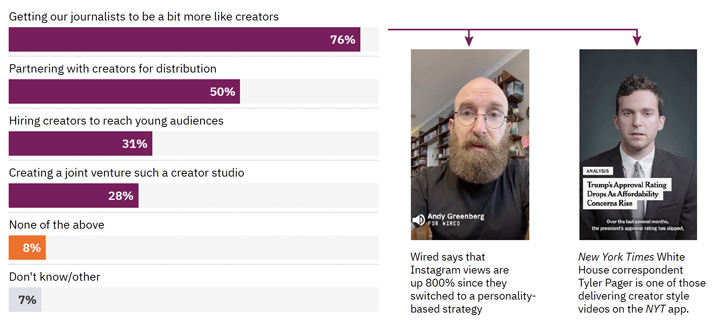
Three-quarters of our publisher respondents (76%) said that they would be getting journalists to behave more like creators this year. Wired, for example, has set out a strategy to build its best-known writers into ‘platform personalities’ – from vertical video on TikTok and Instagram to live events. The New York Times has been putting the faces of its correspondents front and centre on its homepage. The Economist, which for years shunned bylines, has changed its approach in some areas, showcasing key talent through podcasts and newsletters.
This trend raises new issues for media companies that have previously suppressed personalities in the name of greater objectivity or a consistent voice. Another significant risk is that, by helping journalists to build their independent profile, they may be giving them confidence to leave. The Washington Post’s TikTok guy, Dave Jorgenson, worked at the company for eight years picking up many prizes in the process before setting up on his own and taking many of his followers with him.
Publishers will be looking to learn this year from creators about how to build greater connection and stronger direct relationships with audiences. At the same time, they will be focused on reengineering their businesses for the age of AI, with more distinctive content and a more human face.
In terms of formats, they will be looking beyond the article, investing in more video and adjusting their content to make it more ‘liquid’ and therefore easier to reformat and personalise. At the same time, they’ll be continuing to work out how best to use generative AI themselves across newsgathering, packaging, and distribution. It’s a delicate balancing act but one that – if they can pull it off – holds out the promise of greater efficiency and more relevant and engaging journalism.
The full ‘Journalism, media, and technology trends and predictions 2026’ can be downloaded here.
This article was first published in InPublishing magazine. If you would like to be added to the free mailing list to receive the magazine, please register here.