Are you an AI doomer, gloomer, zoomer or bloomer when it comes to news journalism? These expressions cover the breadth of differing responses to the new wave of disruptive technology, from the extremes of existential threat and stary-eyed optimism to more mixed views, from caution and fear to measured positivity.
Many in media could be forgiven for feeling pretty doomer-ish about the future of news – the industry faces multiple threats, from a proliferation of digitally generated news to radical changes in online consumption (from text to video and audio) from users and increasing threats to publishers and journalists from censorship and political attack.
News leaders responding to the Reuters Institute survey (as part of its annual trends report) released in January showed greater pessimism about journalism for the year ahead considering this landscape. Only 38% were optimistic compared to 60% in 2022 – those who were not confident nearly doubled to 18% compared to four years ago.
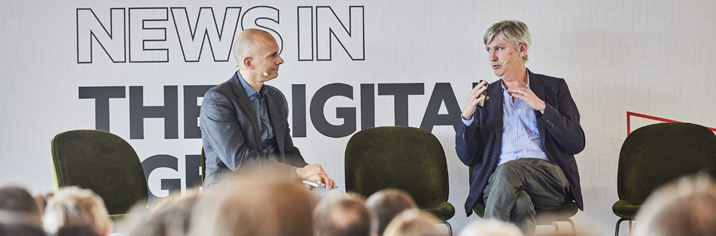
Speakers and attendees at the ‘News in the Digital Age’ event in February – held by FT Strategies and Google – were more glass-half-full about AI. This may have been in part due to the conference being a joint effort between two leading lights in media and technology respectively. A theme across the day was how the future for journalism and news should be defined, driven and navigated by partnership and collaboration across those sectors – a session was devoted to how Google’s NotebookLM AI research tool was born, co-created between writer Steven Johnson and the Google Labs team and the day ended with FT Chief Executive Jon Slade announcing a licensing partnership with Google focused on a series of pilot projects. “I’m excited about what we can create together,” he said.
And those representing the technology side acknowledged some of the concerns that have been raised by media businesses since AI chatbots took off in 2022 – not least the thorny issue of how publishers will receive attribution and funding for creating original news when much of it will in the future be consumed in closed chatbot experiences rather than in their own domains (via traditional search).
Of those concerns, Sulina Connal, managing director of news and books partnerships EMEA at Google, said: “We hear you and we hear you loud and clear.” She added that conversations across the divide are “not always easy” and “complex” but they can lead to progress. It was certainly a case in this event of bridges being built across the two sectors rather than being burnt.
Towards greater adoption
So, how can media businesses successfully grapple with AI? Ana Jakimovska, head of AI strategy at multinational and multi-platform media business Mediahuis offered delegates a four-pillar framework for companies to adopt, starting with the basics of AI knowledge and principles and efficiency improvements, which she saw as building blocks and defensive measures through to more radical improvements to your product offering and platform strategy.
And whilst the firm is developing innovative new systems and products – one is trialling the use of AI agents to carry out writing, editing and legal and fact checks of what it calls ‘first-line reporting’ to support reporters to focus on more original reporting – her most important current initiative is on education and culture change amongst staff. She said her staff’s conceptual understanding of AI was “very high”, but when it came to practical applications of AI and uses of the technology on the shop floor, it was “shaky”. She described the shift as “from unconscious incompetence to conscious incompetence” and the priority was for the company to move from “pockets of high-performance experimentation” in AI to broader adoption.

Culture appears critical – delegates heard later about the change in approach to news reporting and coverage by Al Jazeera. The shift from the global broadcaster was based on how audiences wanted to consume its content in the era of AI and the increasing speed of news dissemination – they were less keen on news packages or on-the-hour reports but craved immersive, non-linear experiences. Managing Editor Mohamed Moawad said this led to a reversal of its newsroom architecture so editors become conductors, directing rather than approving content. He said users wanted “to live the story immersively and know all the details about it and go through the whole process from the raw news until they get to the in-depth analysis of the story.”
New ways of thinking
Others at the event shared their experience of moving out of big news brands – such as Lauren Saks, a co-founder of new video start-up Local News International (LNI) with her ex-Washington Post colleague Dave Jorgenson who left last year and took much of the Post’s audience on social platforms such as TikTok to his new venture. One frustration Saks pointed to with legacy media was a reluctance for these brands to think beyond attracting and building new audiences on new platforms. They need to adapt other areas such as subscription offers and pricing, the way they work with advertisers and sponsors and diversifying revenue streams such as selling merch. “It’s this kind of business support that I think legacy media really is struggling to modernise as well as just bringing in this new audience.”
Adapting and innovating were watchwords amongst news leaders and executives – whilst simultaneously protecting and retaining the core of what journalism is. Demand for original and investigative journalism is robust amongst audiences – the Reuters survey found that news executives were focusing overwhelmingly on original investigations and on-the-ground reporting to compete with AI. However, the industry needs to improve how they present and package their work. Rozina Breen, currently director of editorial at the Pulitzer Center and formerly at the Bureau of Investigative Journalism, said a lot of her work at these organisations was about building more community and engagement around investigative journalism. “If the public can’t access the journalism that we produce, then what’s the point?” Breen pointed to the Mr Bates vs the Post Office drama as a lesson in how journalism can be better packaged and increase its impact on audiences. It was based on brilliant investigative journalism by titles such as Computer Weekly and Private Eye but was only propelled into public consciousness by TV dramatisation. “That’s when the public got angry and wanted to hold government to account,” she said.
Making news entertaining and sticky may be frowned upon by purists but is a powerful way to increase reach and increase returning visitors. Saks says her work with Jorgenson blends “proper journalism” with “a format that uses characters and skits and humour when totally appropriate because we are kids of the Daily Show”.

Concluding the conference, the FT’s Slade offered cautious optimism for the future, pointing to the many benefits AI can offer the profession. “At its best, AI doesn’t replace the editorial process, it supports it. It removes friction, it extends capacity and it creates space for deeper thinking. And when used transparently and responsibly, it can strengthen trust by improving clarity and consistency and accessibility.”
And Slade called for fundamental values such as trust and judgement to help guide the industry through choppy waters ahead. “The real question is whether we allow AI to strengthen judgment or weaken it, and whether it deepens trust or dilutes it as a result. That answer is not pre-written by technology. It will be determined by the choices made by those who design these systems and by the choices made by publishers, editors, engineers and policymakers, and of course, readers.”
The answer to navigating the risks and dangers that AI poses, according to Slade, is to establish an ecosystem where information is not “a raw material, something to be scraped, summarised and recombined without responsibility” but one that recognises “journalism as the product of human judgment, something that carries cost, accountability and value”. AI should not spell the end of journalism Slade said, “but it does raise the stakes”.
AI as a research assistant and “an extension of your memory”
Supporting research and analysis has emerged as one fruitful use of AI by newsrooms. Many examples of this were highlighted at the event from searching massive unstructured databases to a publisher’s or journalist’s own content archive. Newsrooms such as the FT themselves and the New York Times are using AI tools to rapidly sift through vast volumes of documents such as the Epstein files or videos produced by prominent social media influencers such as Charlie Kirk and Tucker Carlson. This drastically reduces the research time from months to weeks.
AI can also be used to look inwards at owned content argued the FT’s Jon Slade. He pointed to their ‘signal from the noise’ experiments, which uses AI tools and semantic reasoning to analyse 40 years of their archive and predict future Bank of England interest rates “with more accuracy than financial markets… that’s helping to potentially redefine our expectations of newsroom output”.
And as satellite imagery becomes more and more accurate, this allows journalists to perform accurate visual investigations such as counting military assets, according to the FT’s head of visual and data journalism, Alan Smith. Journalists are also able to uses AI tools to understand and translate dense and complicated scientific or expert reports into lay language.
Writer and journalist Steven Johnson also elaborated on how AI enables him to interrogate his own intellectual capital. He was able to partner with Google to co-develop its NotebookLM tool which allowed him to store 3m words consisting of his published output (articles and books) as well as 8,000 quotes he’d amassed in his career.
Johnson described tools such as these as “an extension of your memory, which is such an important thing when you’re writing journalism”. He saw uses for the tool by journalists as analysing multiple interview transcripts, fact-checking passages against source documents and employing deep research agents to find external sources.
This article was first published in InPublishing magazine. If you would like to be added to the free mailing list to receive the magazine, please register here.