Way, way back in terms of world events, in January 2026, it was not Iran, Ukraine or Gaza that was in the front line of journalism, but that “big piece of ice” known since 1381 as Greenland.
In a whirlwind few days, President Trump announced he was going to make Greenland part of the United States, threatened anyone who opposed with punitive tariffs and then backtracked on it all before announcing a ‘framework’ for an agreement had been reached.
While the world’s media scrambled to not only find out more about this remote self-governing territory of Denmark but also get there for on-the-spot reporting, the ‘local’ media stood firm in the onslaught.
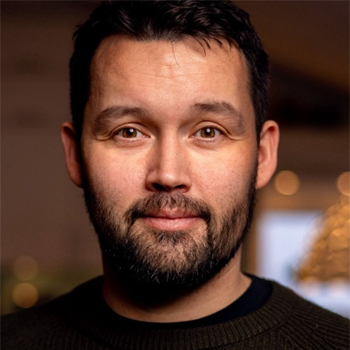
Masaana Egede is the CEO and editor-in-chief of the only Greenlandic media outlet, Sermitsiaq, and suddenly the man everyone wanted to know.
“How crazy it is to see so many people gathered in Nuuk but also to see pictures from the demonstrations in the many cities in Denmark. All with a common goal, namely, to speak out against the United States and stand together for Greenland,” he wrote.
So what better way to harness all this attention, make things a little easier for the newsroom and make a little money too than to launch the ‘Greenland Press Center’.
“The Greenland Press Center is a new workspace created for international media and journalists reporting from Greenland,” reported Egede. “Located at Sermitsiaq, the Press Center will offer a calm, practical base in a landscape where logistics can feel as vast as the ice sheet itself.”
They offered fully equipped workstations, available for long-term and short-term lease, as well as daily, other office facilities including internet and that all important coffee.
An important addition for those foreign correspondents ‘parachuted in’ was a consultancy service. “Reporting from Greenland comes with unique cultural, political, and logistical considerations. We offer consultancy on reporting in Greenland, available on an hourly rate, to help international media navigate context, background, and best practices,” said Egede.
Importantly, they do not offer ‘fixers’ as part of the deal. As Egede says: “The Greenland Press Center is designed to be a reliable foothold – a warm desk, a strong connection, and local insight – while you focus on telling Greenland’s stories accurately and responsibly.”
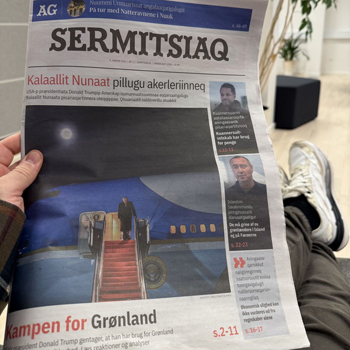
In between all the global diplomacy, Sermitsiaq even managed to pull off a full redesign.
“We are becoming more and more digital, but there are still readers who like a good newspaper in print,” says Egede. “The new format offers all the best stories from the week, long reads, portraits and a little crossword puzzle.”
Kassaaluk Kristensen is the digital redaktør (editor) at Sermitsiaq who was “both proud and happy” to have a staff member in place who covers the events in Washington on an equal footing with the major international media.
“Our talented photojournalist Oscar Scott Carl is currently in Washington and will do his utmost to document and communicate what is happening in these crucial hours. Once again, Greenland is on the agenda – both at home and in international media,” reported Kristensen.
While the focus was naturally on Donald Trump’s repeated statements that the United States needs Greenland, Kristensen had a message for readers: “We’ve got you covered. We must not forget everyday life in Greenland.
“That is why we have prioritised stories that are relevant to us, to our readers’ everyday lives and to our common future. Down-to-earth and important stories that touch on Greenland and life here.
“Regardless of whether Greenland is on everyone’s lips, we maintain our focus: Greenland on the world map – but also stories in Greenland, for Greenland.”
Meanwhile, in Venezuela…
Another global hotspot largely of President Trump’s making was Venezuela.
In January, the US launched an incursion into Caracas, capturing the nation’s president, Nicolás Maduro, and leaving the country in a state of uncertainty over its political and economic future.
Journalists were not allowed into the South American country and camped out on the Columbian border to send their dispatches, leaving the local frontline reporters to tell it how it was on the streets.
In the last 20 years, 16 newspapers have gone out of circulation in the country. More than 200 radio stations have been stripped of their licences and gone off the air.
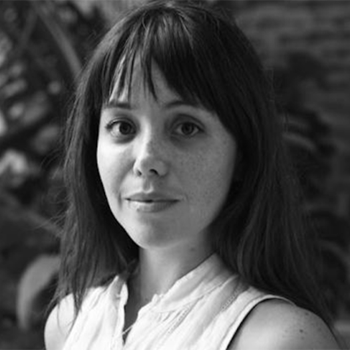
Speaking to Reveal, a nonprofit, independent, investigative radio show and podcast, journalist Mariana Zúñiga related how she woke up in the middle of the night to the sounds of explosions and military planes in Caracas. Her WhatsApp chats flashed the news: The ruling dictator, Nicolás Maduro, had just been captured by the US military. She was surprised and felt uneasy about what was to come.
In the days that followed, Zúñiga would go into the field, despite the dangers journalists face, to report on what the country feels like at this tumultuous moment.
“It was 2:00 AM and I heard some kind of explosion. And I thought, oh my God, I can’t believe they are still using fireworks, like we are three of January. Please just go on with your life. It’s not the New Year’s Eve anymore.
“Then I heard the second one, and I started hearing the planes or helicopters, and I realised, okay, this is not what I thought. This is something else.
Zúñiga then called a friend. “And I asked her, ‘What are you seeing?’ And she told me she was seeing some explosions. Also, I went to my WhatsApp because we have to remember that in Venezuela, most media are censored. That’s our way to get our news.”
“In WhatsApp where you search for words like Maduro, or Trump, or invasion, that kind of things, a lot of people are still very, very scared to talk, or to celebrate if they want, or just to mention something because even if Maduro was captured, was taken out of the country, for many people, the regime are still in place.
“We still don’t know in which or what extent Venezuela is willing to implement reform. So this could be the beginning of a new political era or just more of the same old regime.”
Expert view: Don’t just show up in a new country
David Trilling worked for ten years in the former Soviet Union and Middle East and as The Economist’s Central Asia correspondent. As a Knight-Bagehot Fellow at Columbia Business School, he has some pithy advice for foreign correspondents: “Don’t just show up in a new country. Read and do your homework before you go.
“Knowing the scene will help you avoid clichés and stereotypes in your coverage. Keep in mind the problems that “parachute journalists” – those who jump into a situation and then jump out – can create for the journalists who are based in the country.
“Sweeping generalisations and mischaracterisations can anger local groups and make all journalists targets of annoyance or worse. The best stories bring nuance to a situation; ideas for these pieces tend to come about after a lot of reading and talking to people on the ground.”
On the front line in Afghanistan
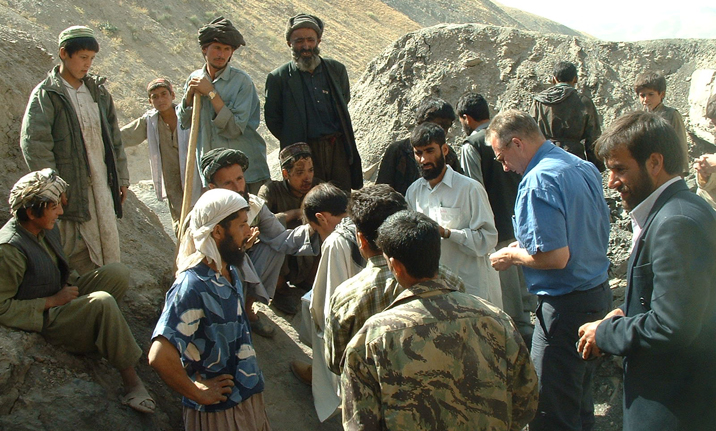
I had my own brush with frontline reporting in Afghanistan shortly after the first fall of the Taliban following 9/11.
Based in central Kabul, I helped run a programme for the Institute of War and Peace Reporting (IWPR) trying to establish a robust media to assist civil society efforts.
We had an open house to assist anyone who called themselves a journalist or wanted to be a journalist. There was no formal journalism education or training in the country just the remaining vestiges of Russian-style journalism from the previous occupation, so it was a pretty open field.
Journalism was loosely allied to ‘liberal arts’, so we had poets, playwrights even sculptors line up to learn some basic journalism of accurate reporting and truthful representations of what people said.
It wasn’t easy. Facts were hard to come by, officials difficult to pin down and everybody very mistrustful of speaking out. However, spurred on by the $50 payment for getting something posted on the website, stories of everyday struggles with food, housing and healthcare found a wider audience.
Some of the new reporters turned into talented operators and even went on to found Pajhwok Afghan News, now Afghanistan’s largest independent news agency. My former go-to reporter Danish Karokhel is now CEO and editor-in-chief of the agency.
There were few Western journalists based in Kabul at that time. The BBC had a house which doubled up as a studio in the hills overlooking the city fronted by the seemingly always-on Lyse Doucet, who could conjure up formidable reports from the scantiest of information.
I lived next door to a guest house run by Peter Jouvenal, legendary British award-winning television producer, who had also worked as a journalist covering the wars in Afghanistan since the Soviet occupation in the 1980s. Jouvenal filmed CNN’s infamous interview with Osama bin Laden in 1997.
He had a moving tableau of journalistic luminaries staying with him, including photographer Steve McCurry who captured the startling ‘Afghan Girl’ picture, much reproduced over the last 40 years.
But, mostly, it was transient visitors who were parachuted in to report back to Europe, America or Australia with a flavour of what was happening in this world hotspot. Some gravitated towards the IWPR compound close to the city centre as we had the double-whammy of local journalists on the ground plus an editor (me!) with an ear and an eye of what would work well back home.
I confess it was a little frustrating with some ‘foreign correspondents’ happy to sit back while we emptied our notebooks, but after a few practice runs, we got better at being just helpful enough to keep them onside while also providing some good training exercises for the local reporters.
The man from the Baltimore Sun even offered to take me out “for a few beers”. Yeah, a steep learning curve getting to grips with Islamic culture…
This article was first published in InPublishing magazine. If you would like to be added to the free mailing list to receive the magazine, please register here.