It takes an extraordinary set of statistics to bring a tear to the eye and a sense of rage in the chest of a hard-nosed journalist. But the following figures had that impact on me.
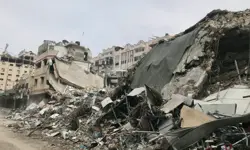
More journalists have been killed in the current Gaza conflict (the vast majority by Israeli military action) than the journalistic death toll combined in the US Civil War, World War I, World War II, the Korean War, the Vietnam War (including the related Cambodia and Laos actions), the Yugoslav civil wars of the late 90s and early 2000s, the Iraq war and the post 9/11 battlegrounds of Afghanistan. That’s according to research by the highly respected US-based Watson Institute for International and Public Affairs.
Please stop for a second and re-read those stats before reading on...
An historic day for journalism
It was against that backdrop that a remarkable moment in journalistic history took place on September 1st when more than 250 media outlets around the world staged front page, inside page and on-air protests highlighting the killing of 200-plus (and rising) journalists by Israel in Gaza, together with renewed demands that the Netanyahu government lifts its ban on independent international media entering Gaza to report on the conflict.
In the UK, the Independent’s online cover was blank except for the words across the bottom, ‘At the rate journalists are being killed in Gaza, there will soon be no-one left to keep you informed’.
That was an extract from the launch statement by Thibaut Bruttin, director of Reporters Without Borders (RSF), one of the media campaign groups behind the September 1st global protest day.
The Guardian chose not to blank out its front page but devoted two-thirds of it to the images of five journalists slaughtered in a particularly notorious double strike on a hospital, with the headline, ‘The deadly war on journalism in Gaza... at least 189 journalists have been killed in 22 months’. Inside, the paper gave another three pages to the background stories of some of Gaza’s toll of slaughtered journalists as told by surviving family members and colleagues. Online, it ran the images of almost 200 media casualties.
The August 31st edition of The Observer ran a full page headlined, ‘No one wants to live in a world where journalists are killed live on television’... quoting Plestia Alaqad for whom exactly that happened with the footage of the Nasser hospital double strike that killed five of her colleagues among twenty fatalities. “I’ve always thought of journalism as a noble profession, but I never knew being a Palestinian journalist is a crime,” she has written in a poignant memoir titled, ‘The Eyes of Gaza’. Among the journalists killed in the Nasser hospital carnage were award-winning AP camerawoman Mariam Dagga, Reuters cameraman Hussam al-Masri and Al Jazeera photographer Mohammad Salama.
Double taps are doubly illegal
The Nasser hospital massacre is a particularly graphic and shocking case. So much so that Israel’s prime minister Netanyahu expressed rare regret over a ‘tragic mishap’. But the ‘double tap’ strike involved is a clear breach of international law. The IDF claimed its initial target was a camera set up by Hamas to monitor its troop movements. But it possibly mistook journalist al-Masri’s camera set up for a Reuters live feed for a Hamas ‘spy’ one. Even if that’s true, it can’t justify the second illegal ‘double tap’ strike that killed those, including more journalists, who were rushing to reach those killed and maimed in the initial blast. Without producing evidence, the IDF suggested some of the ‘rescuers’ were Hamas operatives and Israel has so far rejected media organisations’ demands for an independent international investigation into what happened.
“Regardless of whether the journalists were the target, this is still a war crime,” argues Sara Qudah of the Committee to Protect Journalists (CPJ): “The Israelis hit a medical complex known to be a place with media and civilians inside. The double tap itself is a war crime.”
Assassination admission
As a general rule, Israel denies deliberately targeting journalists and suggests Palestinian media deaths and injuries are collateral damage in their attacks aimed at Hamas terrorist locations. International media organisations strongly challenge that assertion. But in a recent break from its normal denial policy, Israel has acknowledged the deliberate August drone strike assassination of another award-winning Al Jazeera correspondent, Anas al-Sharif, who it claims — but without compelling evidence so far — was a secret senior Hamas operative. But even if true, would that justify the slaughter of the four colleagues who perished with him?
Inevitably, obtaining precise figures for media deaths in Gaza is difficult and, sadly, the statistics are bound to increase between me writing this piece and its publication. That said, the figures at the time of writing are worth noting.
The New York based Committee to Protect Journalists (CPJ), headed by Brit Jodie Ginsberg, who formerly ran Index on Censorship, puts it at 189 minimum.
The Gaza Media Centre puts it at 238, the UN Human Rights Office at 247 and Amnesty International at 240. The UN officially designated the war in Gaza the worst in history for journalist deaths, with its secretary general Antonio Guterres declaring, “Journalists in Gaza have been killed at a level unseen by any conflict of modern times.”
The historic September 1st global protest was organised and supported jointly by Reporters Without Borders, the global campaign movement Avaaz, the CPJ and the International Federation of Journalists (IFJ). Four complaints have been filed at the International Criminal Court for war crimes Israel’s military has allegedly committed against journalists in Gaza.
‘A war on journalism itself’?
The RSF’s Thibaut Bruttin’s official launch statement put it this way: “At the rate at which journalists are being killed in Gaza by the IDF, soon there will be no one left to keep the world informed. This is not only a war on Gaza, it is a war on journalism itself. Without them, who will speak of famine, denounce genocide, expose war crimes?”
The basic question at the heart of the September 1st global protests is the obvious one. If Israel has nothing to hide, why is it so insistent on banning the international media from entering Gaza to do its own independent reporting and investigations?
One Israeli government official put it to me this way: “We want to protect international journalists from being accidentally killed and the fallout that would come with it.”
Sorry, not convincing. If international news organisations are prepared to take the risk — and I know plenty of seasoned British war correspondents willing to do so — then it shouldn’t be Israel’s self-serving right to refuse them.
The organisers had hoped their action and the surge in journalist killings, might move President Trump to put pressure on his ally, Israel’s prime minister Benjamin Netanyahu, but so far, Trump’s response hasn’t gone beyond: “I’m not happy about it. I don’t want to see it. At the same time, we have to end that whole Gaza nightmare.”
But so far, no sign of the Gaza “nightmare” ending or the death toll of Palestinian journalists there doing anything but going upwards. Not least as Israel pushes its way into Gaza City and seeks effective total control of the Gaza strip and the mass forced relocation of the whole population. With the omnipresent suspicion that the Trump administration will ultimately ally itself with the Israeli hard right and its ambition to absorb both Gaza and the West Bank into a ‘Greater Israel’ in defiance of international law and contrary to longstanding UN resolutions.
But one small victory is that many news organisations relying on courageous, death-defying Palestinian journalists — including the BBC, Sky, ITN and Channel 4 News — now make a point of routinely marking their bulletin coverage with the essential reminder that Israel refuses to allow them to send their own independent journalists into Gaza.
Sources
- Committee to Protect Journalists: www.cpj.org
- International Federation of Journalists: www.ifj.org
- Reporters Without Borders: www.rsf.org
This article was first published in InPublishing magazine. If you would like to be added to the free mailing list to receive the magazine, please register here.