Caitlin Moran is talking about a conversation she used to have a lot with a musician friend. “I would tell him all the time how brilliant his music was,” she says. “Then I would leave a pause for him to say the same about my writing.” She takes a breath to build anticipation. “But because he was a cool indie boy, he just would not rise to the bait. In the end, I went, ’Come on. I’ve literally spent three hours telling you how incredible you are. Tell me why I’m great’. He went, ’Your writing… It’s just a bit chatty’.” Moran laughs. “He thought that was a diss, but ninety per cent of my energy goes into making my columns as conversational as possible. When I write those pieces, they’re supposed to be a stand-up routine. If I wasn’t socially anxious, I would have been a stand-up comedian.”
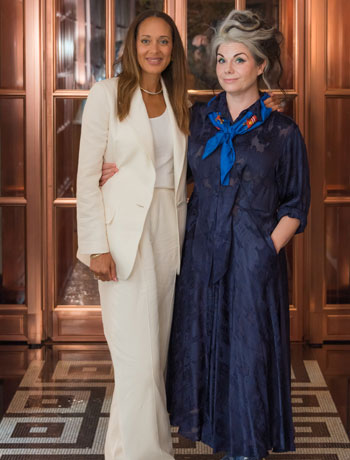
Moran is as funny and chatty in interviews as she is in her columns. She has been writing for The Times for more than 30 years and believes the paper still wants her partly because readers warm to her chatty tone and partly, she jokes, because people like familiarity. “I’m just there,” she says. “That’s just where I am. See you every Saturday and Thursday!” She is talking today to Andrea Thompson, chair of the BSME (the British Society of Magazine Editors) and editor-in-chief of Marie Claire. We are at the Rosewood hotel in London. They are launching the BSME Young Writers’ Prize to give people the opportunity Moran once had to break into mainstream publishing.
Moran was twelve when she won an essay contest that made her think “writing’s for me”. She wrote because she loved to read. She also wrote out of boredom and because she hoped it would offer a way out of poverty. “I had a Dickensian background,” she says, recalling her childhood on a three-bedroom council estate in Wolverhampton. “There were eight children. My parents decided to home educate us, but what that really meant is that we watched a lot of 1950s MGM musicals and work by Rik Mayall.”
With no set schedule, she had to find ways to fill the time. “When I was about thirteen, I clocked that one day I would have to earn money. The only way I knew you could do that if you had no resources and no friends and no education was to write because that’s what Jo does in Little Women and that’s what the mother does in The Railway Children.” Moran decided she would write a book. She estimated that it would take her the same amount of time to write one as it did to read one. She was a fast reader; she could get it done in a day. Three years later, her novel was finished. The Chronicles of Narmo, about a home-educated teenager from a big family, came out in 1992. Moran was seventeen.
An invitation to write
Towards the end of this marathon-writing session, Moran entered the Observer’s Young Reporter of the Year competition. “Everybody else took the brief very seriously,” she says. “You had to write a news report about something that had happened in your local area, like a celebrity coming or the opening of a new community centre. I wrote a piece about us trying to wash my brother’s hair in the style of Kate Adie.” The judges were impressed with Moran’s writing and she won. As a bonus, the Observer gave her a column over the summer. Her last one, in August 1990, was spiked. “They didn’t say why,” says Moran. “So, in a huff, I went to the newsagents around the corner and faxed it to The Times.” By the time she had got home, The Times had called to say they would publish it.
Moran’s impulsive reaction to the Observer paid off. She found out later that the paper had dropped her column because the Gulf War had broken out. They had to write about that.
Winning the Observer prize, Moran says, was another sign that she should continue to write. “It felt like someone in London reaching their hand out across the country and going, ’you can have a writing job’,” she says. “We’re inviting you to do this. That’s what I now want this new prize to do for someone else.”
It would take one further conversation for Moran to realise that writing a column could become her career. “If you’re living on a council estate and the only people you know are people who can steal you a bag of gravel from Wickes, you’re not [aware] that there’s a job being a columnist,” she says. You’re more likely to consider being a writer if you have a middle- or upper-class background or have gone to private school and your parents know people who do that sort of job. It’s that whole thing of, I cannot be what I cannot see.”
When her book was published, Moran was interviewed by The Times writer Valerie Grove. “It was a big deal,” she says. When Grove switched off the tape recorder, Moran asked her how you can make money as a writer. “She said, ’you need to be a columnist’,” Moran says. “Then you would earn money every week.” For research, Moran scooted off to her local library to read all the anthologies of columns she could find: Alan Coren, Jilly Cooper, Katharine Whitehorn, Sue Limb. Her path was mapped out.
Honing her craft
Moran has mastered a way to tackle difficult subjects — feminism, mental health, abortion — with an honesty and frankness that connects with readers. Often, she uses humour. “It should never be an effort to read a piece,” she says. The more serious or worthy a topic, the more a writer should try to make it a joy to read. “I don’t believe that reading about feminism or racism or mental health should make you feel like you’re eating a big bag of fibre,” Moran continues. “It should be as joyful as reading a review of a pop band or someone talking about how much they love dogs.” If you strive for that sort of approach, people will want to read your work. It is also important to go through a draft as if you’re a reader. “You need to forget that you wrote it,” Moran says. “You need to ask yourself, ’What do I, as a reader, want to happen now? Is this a bit boring? Do I understand this? I want a joke now.’”
Moran has been honest and frank in her writing about her own mental health. She is writing a new book at the moment called ’How to be Hopeful’ and talks of how she has changed her life over the past few years to overcome anxiety or, as she calls it, her “best bad friend”. “I owe everything I have to anxiety,” she says, comparing the adrenaline and noradrenalin produced when you’re anxious to being on amphetamines. “When your body is flooded with these drugs, you are incredibly productive. Your brain is superfast and sharp.” She worried initially that letting go of that nervous energy would kill her writing talent. It didn’t. “I work more now than I did before,” she laughs.
When Moran has written about aspects of other people’s lives, such as her daughter’s anorexia, she has been careful about how much she has revealed. “It might seem as if I share everything about my life, but if you look at the substance of what I’ve written, it’s a trick,” she says. “I will tell you one small thing and then go on to talk about the issue in general. You would be astonished at how secret and mysterious I actually am!” A column might appear to be confessional, but it should always offer the reader something more. “If you’re going to talk about a big subject, you need to give the reader a bit of gossip at the start. You use that to then talk about the issue — that’s where you do the actual writing.”
Moran usually knows what she will write before she starts typing. She keeps notes on her phone that she will top up when she’s walking the dog or cooking. In her columns, she likes to take people on a journey, inviting them to “have a chat” about a subject, before “trotting through what’s happening” and “landing something unexpected at the end”. “You should not be able to guess what my last section is going to be from my beginning,” she says. “Really, there’s no such thing as writing. It’s just thinking. You’re not a writer. You’re a thinker.”
This, says Moran, is why AI will never replace great columnists. It can’t think and it certainly can’t feel. “AI doesn’t understand feeling shame. It doesn’t understand feeling scared. It doesn’t understand feeling love for your child. People want to read about someone’s emotions.” If readers are looking solely for information, then AI has a strong claim. If they want to connect with someone who understands how they feel, columnists, Moran argues, are safe. “Do you really want to listen to the confessions of a robot?” she says. “Or do you want to listen to the confessions of someone who’s telling you the story of their life?”
The BSME Young Writers’ Prize with Caitlin Moran
The BSME is launching a new award to find talented writers aged 18-25 from across the UK. The winner will be awarded a bursary and be mentored by Caitlin Moran. More details are available on the BSME website. For further information, contact Nathalie Ginvert: nat@bsme.com
This article was first published in InPublishing magazine. If you would like to be added to the free mailing list to receive the magazine, please register here.