Last year, Culture Secretary Lisa Nandy raised eyebrows at the Society of Editors conference by cancelling her scheduled appearance at short notice citing a diary clash, while failing to provide a substitute.
She more than made up for it this year with a powerful speech on the media’s central role in helping to create the civic realm without which democracies cannot flourish.
It came complete with important announcements on financial support for local news outlets, including local newspapers and community radio, plus the promise of significant long-term changes to the status of the BBC.
A senior editor at the conference suggested privately it looked as if she had just emptied her in-tray.
Nandy expressed concern about the loss of nearly 300 local newspapers over the past 20 years – 22 in the past four years alone – and the creation of “news deserts” where millions have been left without any dedicated local news provider. News deserts where disinformation can flourish and local authorities cannot be held to account.
Local media outlets in print, online, radio or TV will be able to apply for grants to a new centralised Local News Fund which will have £12 million to distribute over two years. Some of the money can be used for sustaining financially viability but most will go towards helping media outlets make the transition to digital business models.
“For people to trust one another, there has to be shared understanding, shared facts, shared moments and experiences. This is the meeting point, the common ground, the ability to understand one another on which a country is built,” the culture secretary said.
Nandy added that when local journalism declines, trust declines with it, accountability weakens, and voices across the UK are silenced.
The culture secretary also welcomed the fact that the Competition and Markets Authority had found that Google had “substantial and entrenched” market power over general search and search advertising and was working on a regime designating the search company as having strategic market status.
“We will work closely to ensure this is fit for purpose and we will not hesitate to do more if needed,” Nandy promised.
If one anchor in the current was the local media, another was the BBC which she described as being “a bright spot on a bleak landscape”.
She had news for the corporation. The current negotiations for what was going to be a new 10-year Royal Charter for the BBC would be the last.
While there would still be negotiations every few years about the BBC’s structure and funding, she planned to end the “bizarre situation” where if the charter was not agreed in time, the BBC would cease to exist.
“We would not accept this for the NHS, and we should not accept it for the BBC. This is about protecting the BBC – and everything that it represents – for the long term, for all of us,” Nandy said.
But in return for a continuous Royal Charter, the culture secretary will seek greater accountability from the BBC at every level and that public service should be at the core of everything the organisation does.
Nandy also took a swing at GB News, without naming the channel, which has recently been described by Andrew Neil as “Reform TV”.
Nandy said it was unacceptable to have elected politicians presenting news and potentially blurring the difference between fact and polemic. She said she was exploring action in this space.
The culture secretary said she was not going to intervene in independent press regulation but implied she expected a more robust performance from IPSO, the Independent Press Standards Organisation. She noted it upheld only one cent of complaints and had never imposed a fine despite having the power to do so.
The record on fines is correct but IPSO recently pointed out the one per cent figure is misleading because it often adjudicates on a sample single complaint even though many may have complained about the same incident.
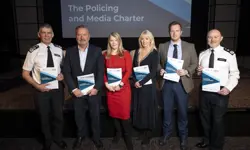
Earlier, more news had been made at the conference with the launch of The Policing and Media Charter designed to govern police and media relations in future.
Police relations
A perennial theme of the Society of Editors conference in recent years has been the “broken”, sometimes almost non-existent, relations between the media and the police.
The problems date back thirteen years to the Leveson Inquiry. Journalists complained about unanswered phones, being unable to find the phone number of a police press officer or receive background briefings. Many police forces communicated by pushing out information, generally online.
Matters came to a head over the Nicola Bulley case in January 2023 when so little information was provided by police about the missing woman that a vacuum was created that was filled by misinformation, and conspiracy theories on social media.
A report by media lawyers, editors and crime reporters made 26 recommendations, which have now been accepted.
They include police provision of mug shots for those who have received custodial sentences and even body cam footage where it is available.
Officers and staff of all ranks can engage with the media “if there is a policing purpose” and forces in England and Wales will be required to give background briefings to accredited journalists during high profile and fast-moving investigations.
Rebecca Camber, crime and security editor of the Daily Mail who chairs the Crime Reporters Association described the agreement as “ground-breaking” and Sir Andy Marsh, chief executive of the College of Policing said it would be a re-setting of the relationship between the police and the media.
“We need to talk to you in good days and bad,” said Sir Andy who acknowledged that some in the police still feared talking to the media.
“We must deal with that,” Sir Andy conceded.
Tackling misinformation
Unsurprisingly, there was considerable thought given to the difficulties of reporting current wars and President Donald J Trump at the conference.
A distinguished panel of foreign correspondents agreed that misinformation and conspiracy theories had been turbo-charged by social media.
Stuart Ramsay, chief correspondent of Sky News lamented the fact that there was “a growing body of people who won’t believe anything they don’t already believe themselves”.
Ramsay, who was shot in Ukraine, told how a 17-year-old cousin challenged him at a family gathering saying he didn’t believe he had either been in Ukraine or had been shot. He had to bear his wounds to prove it.
Ramita Navai, journalist and documentary maker told of the difficulty dealing with the BBC in making Gaza: Medics Under Attack.
She says she was told by BBC executives not to use the word “genocide” or the term “ethnic cleansing” and warned not to use information from the UN or Amnesty International. When it was pointed out that UN and Amnesty material was used from all over the world by the BBC, a BBC executive admitted he was talking about UN and Amnesty information on Israel.
The BBC shelved the documentary on impartiality fears. It was later broadcast by Channel 4 without any problem.
Ramsay noted that “we all get hassle from Israel not just the BBC”.
Anthony Loyd, special correspondent for The Times, who has been covering wars for 30 years, told of how total disinformation can have serious personal consequences.
He told of being in Northern Syria where Turks, or Turkish-inspired Kurds, were attacking. He heard terrible screams and a 13-year-old boy burst into the room with 65-per cent burns. He was unlikely to make it but Loyd contacted Save the Children, the 13-year-old was evacuated and survived.
Loyd was attacked on social media for making the story up, for being an SIS agent, amid claims that the boy had been an actor.
More than four years later, Loyd was travelling through Istanbul airport when he was hauled off a plane and detailed as an “enemy of the Turkish state” – a status that meant the Foreign Office was unable to intervene.
On Trump, Paul McNamara, chief political correspondent at Channel 4 News noted that there were now many journalists in the US who could fact-check Trump in real time.
But when he went recently with a Channel 4 team to make a documentary on ICE and Minnesota, everyone deleted everything about the programme such as shooting schedules and contacts from their iPads and phones.
Only in the America of Trump.
Increasing use of AI
The conference showed lots of innovation happening across the media. They include a growing use of AI in particular circumstances such as using AI to scan vast quantities of “open source” material of all kinds.
Manisha Ganguly, an investigative journalist and visual forensics lead at The Guardian uses technology to study casualty numbers and such things as shrapnel distribution and patterns.
She investigated a shooting in Gaza by asking doctors to take pictures of bullets removed from injured patients. They turned out to be standard issue Israel Defence Force bullets.
Alessandra Galloni, editor-in-chief of Reuters, revealed that her parent organisation Thomson Reuters was spending around $200 million a year in developing AI across the organisation. Reuters uses AI for simple company results reports to free journalists for more important stories – although nothing leaves the office without being checked by humans.
Asked what the greatest challenge was, Galloni replied that apart from keeping her journalists safe, it was getting them back in the office at the main hubs of London, New York and Singapore.
She admitted using pizza night and drinks nights as inducements but said that three days a week in the office was mandatory and four “highly recommended”.
But despite the range of difficulties facing all editors, Galloni insisted: “This is the best time in the world to be a journalist.”
Many will agree but the cost can be high as Sebastien Lai made clear in a video appeal to campaign for the release of his father, the imprisoned Hong Kong publisher, Jimmy Lai. The 78-year-old Lai, already serving a five year-sentence, has just been given another 20 years – in effect a death sentence.
“Here’s a man who, if we think about free press, freedom of expression, has taken the principle to its end,” Sebastien Lai said.
The editors at the conference signed a petition calling for the release of Jimmy Lai.
For more pictures from the event, go to: www.societyofeditors.org/events/2026-future-of-news-conference/2026-gallery
This article was first published in InPublishing magazine. If you would like to be added to the free mailing list to receive the magazine, please register here.