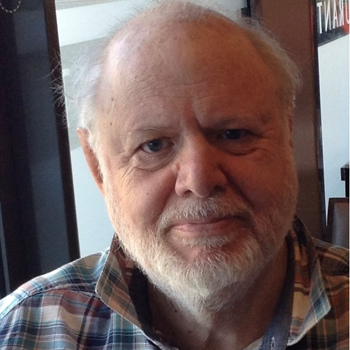
Journalist Geoffrey Lean is not in the Guinness Book of Records but he could and should be.
After 56 years as an environment correspondent, and helping to create the specialism in the first place, Lean can lay claim to the title of the longest serving environment correspondent in the UK and probably the world.
“If there is another, I have never met them but there was a Japanese journalist around for some time,” says Lean whose career includes more than 40 years mainly writing about environmental issues on the Yorkshire Post, The Observer, the Independent on Sunday and six years writing a weekly half page for the Daily Telegraph.
Lean does not say he was the first – that title, depending on definitions, goes to the likes of Jeremy Bugler and Jon Tinker – but as he ploughs on at the age of 79, there is really no doubt that he is the longest-serving, a record that becomes more unassailable with every day that passes.
Recently, he came across an article he wrote in 1974 which argued that the science of greenhouse gases was well understood “and that eventually it might endanger the world”.
At the time, he says only dissident scientists were issuing such warnings and he “was very much out on a limb then”.
Across a summer of record-breaking temperatures, devastating forest fires and tragedies such as the floods in Tibet, almost certainly caused by a collapsing glacier because of global warming, such fears are the new orthodoxy – or are they?
In particular, how well is the media doing in alerting the populace to what could be an existential threat?
Looking across more than 50 years of reporting, Lean’s approach appears almost unnaturally balanced and nuanced.
“There is a lot of good coverage on climate change. I’m not blaming the journalists in any way,” says Lean who concedes how difficult it is, apart from individual disasters, to turn long-drawn out, slow-moving processes into news stories.
“How do you illustrate thousands of deaths from heat waves? It’s easier to show people having an ice cream on the beach,” Lean concedes.
Recently, BBC Radio 4 reported the news that August had been the joint hottest month on record, 1.65°C above pre-industrial levels. It was the fourth item in the bulletin, followed by the news that a BBC programme on drag queens was being cancelled.
“There’s a lot of that,” Lean responds wearily.
While clearly he does not want to be a Cassandra figure forever issuing unheeded warnings, Lean has many pertinent observations from his long career.
One is that while there is now extensive coverage of climate change, there is little sign of journalists covering the whole gamut of the environment in the way he has done.
“There is very little on nuclear power, on challenging the government and very little on the housing crisis,” notes Lean.
At risk of backsliding
On the reporting of climate change itself, he emphasises a significant anomaly – a breaking of the link in coverage between net zero and climate change and a falling off in support for the ‘net zero by the year 2050’ target.
Research for The Conversation, the digital analysis publication, Lean notes, looked at no less than 73,000 articles in the British national press and found a clear change over time.
In 2018, the year the net zero target was introduced by the then Conservative Government, 90 per cent of articles mentioning net zero also include the phrase ‘climate change’ or a similar term like ‘global warning’.
By 2024, this had dropped to just 42 per cent. The research found that the reduction in climate change mentions in net zero articles was particularly marked in The Sun, the Daily Mail and the Daily Express compared to the Guardian.
The clearest example of the change in attitude came from the Daily Mail which in 2019, carried a headline during the youth climate strike: “Net zero hero! How being carbon neutral will help the planet”.
In September 2024, the paper had the headline: ‘‘Bonkers’ net zero target could cost 1 MILLION jobs, union chief warns’ over an article which had four mentions of net zero but no mention of climate change.
As support for the net zero target seems to be lessening, Lean believes “the big issue should not be about net zero by 2050 but if that will be enough. The question is, if we go over 1.5°C, will there be a permanent irreversible change in climate?”
Underreporting the environment
The specialist journalist also highlights what he believes is a long-standing mismatch between the interests of readers and the coverage they receive on the environment.
He argues that over the years, opinion polls have consistently shown that the public are interested and concerned about the environment and support action.
At the moment, Lean argues, about 75 per cent are in favour of action on climate change with even 60 per cent in favour of net zero with only around 25 per cent against, despite the increasingly negative publicity the target attracts.
There are even larger majorities in favour of increasing renewables, protecting the Green Belt and safeguarding nature.
“This degree of concern is being reflected in newspaper campaigns over sewage pollution, but as far as I can see nowhere else,” says Lean.
Geoffrey Lean always wanted to be a journalist right back to primary school days when he set up a little newspaper. It was closed down after two issues because it was too honest about sports results and too critical of teachers.
At Oxford, history not science, Lean met an old friend of his father, the late, great Philip Howard of The Times who was just starting a diary on the paper. Lean concentrated on feeding him Sunday for Monday diary items at six guineas a pop.
They helped win him a traineeship on the Yorkshire Post which came with a year on the Goole Times.
The future career as an environment correspondent was, however, a matter of luck or chance.
“The really excellent news editor at the time, Derek Foster, used to scan the local weeklies, cut out paragraphs worth pursuing and distributed them among his reporters,” Lean recalls.
Testing the water
One he received was about a shortage of smokeless fuel in Yorkshire, another about weak bridges in the county and in 1972, more than 50 years ahead of Feargal Sharkey, with technical help, he took river water samples above and below suspected polluters and proved his case.
Lean the environmental journalist was off and running and later, there were stories, which got a lot of attention at the time, on the dangers of asbestos and lead in petrol which helped to spur campaigns.
Lean believes he has also been lucky about being able to work mostly on Sunday newspapers with time to develop exclusive stories.
The downside was the danger of working on a story all week and then “get scooped on a Saturday by The Guardian or The Times”.
There is no space to record all the journalistic awards he has won – they include a British Press award for Scoop of the Year and the Martha Gellhorn prize for investigative journalism. Consultancies have included work for the World Bank and UNESCO and his books, a study of the Chernobyl nuclear disaster.
As he says dramatically; “I have had breakfast with Willy Brandt, lunch with Mikhail Gorbachev, drinks with Margaret Thatcher and dinner with King Charles at Sandringham.”
Yet, rather surprisingly given the pressing importance of his chosen subject area, his career as a regular journalist on national newspapers came to a sudden end in 2016 when the Daily Telegraph did not renew his contract.
“I don’t know why. I think people on the paper were moving against the environment stuff, although there was also cost-cutting going on at the time. Maybe they wanted someone less like me,” suggests Lean.
Since then, he has freelanced.
“People ring me up and I do it,” he says while admitting that he would like the phone to ring more often.
Meanwhile Lean does two tweets a day to highlight stories he believes should get more attention. A recent example included a warning that the emerging super El Niño could lower water levels in the Panama Canal “severely restricting shipping passing through it, with global economic consequences.”
What we should be writing about
But are there any insights, wisdom to inform what we and the media should do next?
As it happens, quite a lot.
Coverage should be wider and cover the whole environment and it should be more analytical, Lean argues.
More important than that, paradoxically, he believes there should be greater concentration on other greenhouse gases and pollutants rather than on CO2.
“Carbon dioxide is completely intertwined with our economy and bloody hard to get rid of,” notes Lean who adds that CO2 can last for thousands of years yet makes up less than half of the problem.
Concentrating on methane, which lasts about a decade “could be our get out of jail card”.
Or, as he put it in a tweet: “Madness. Methane is 80X more potent than CO2 in heating the planet. Cutting it is the best way of averting runaway climate change, preventing up to 0.3 per cent of warming by 2040 with cost effective measures.”
Methane should be tackled first but hardly gets covered at all. More action should also be taken against ozone and fine particulates, or soot, from diesel and wood burning stoves.
Such particulates absorb light and turn it into heat but only last from a few days to a few weeks.
“I cover all these stories. There are an endless number of stories to be written about the environment,” says Lean.
And perhaps looking back to his days on the Yorkshire Post when he wanted to become a foreign correspondent or a political editor before the environment got in the way, Geoffrey Lean delivers a journalistic mantra: “a story is a story is a story, and a story will tend to get in”.
This article was first published in InPublishing magazine. If you would like to be added to the free mailing list to receive the magazine, please register here.