Q: How?
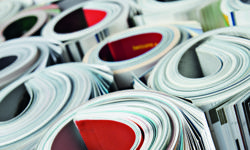
A: Print isn’t just surviving, it’s thriving. In a crowded market, however, one age-old challenge remains: how do you make your magazine stand out?
The answer may lie not just in compelling content but in fully embracing the creative and technological capabilities of print itself and harnessing these to help make your publication stand head and shoulders above the rest.
Leaning into the strengths of the actual printing process itself is a good starting point.
Print is a physical medium: the feel of the paper, the smell of the ink, the texture of the cover all contribute to an experience that engages the senses, creating an emotional connection and response. Advances in modern technology capitalise on this, pushing the possibilities of print further than ever before.
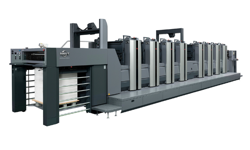
The innovation in press technology in the printing industry over the last few years has been astounding. What was “fantastic print quality” five years ago has been eclipsed by the latest technology; the most advanced offset litho presses delivering incredibly high-definition print with rich, saturated colours, super sharp images and crisp text, making content spring to life and pages sing across all paper types and weights.
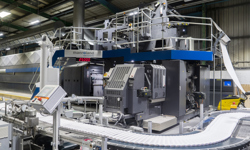
Chemistry-free computer-to-plate technology produces impeccable printing plates whilst in the press hall, continuous inline colour monitoring, closed loop colour control, push-to-stop technology and automated plate loading delivers quality imaging with consistent results and at eye-watering print production speeds, improving turnarounds and efficiencies which also improve work practices, ultimately benefiting both publisher and printer and positively contributing to the overall finished product.
Using reel-sheeted paper reduces waste and improves sustainability as does the selection of responsibly sourced paper, printed with vegetable-based inks. These important sustainability credentials provide a wow factor in a different way adding ethically responsible credibility without sacrificing quality or creativity.
The addition of a Pantone, metallic or neon ink to the standard CMYK range adds an extra dimension and experimenting with different types of paper within a publication enhances sensory engagement. Incorporating a section of uncoated text stock in a publication that is printed primarily on silk provides a striking contrast which can highlight a topic or a promotion, not only drawing attention to the feature but adding a creative and tactile layer elevating the overall impact of the publication.
The cover of a magazine offers huge scope to grab attention. A visually arresting cover invites readers to interact before they’ve even turned the page and a combination of creative finishes can be used to great artistic effect.
A matt laminate with a spot uv is a classic combination, traditionally used to highlight a heading or text but it can be used to huge creative effect by creating highly effective all over patterns for a stunning visual feast.
Foiling conveys luxury and embossing provides a tactile experience, literally giving your cover a third dimension.
Inside the publication, you can be creative with layouts and insertions. Rollfolds within the text and gatefold covers invite the reader to actively engage with the publication as well as potentially offering additional revenue streams, whilst bellybands wrapped around a publication or to a found page add an extra point of engagement.
Die-cutting is another powerful tool. A shaped cut-out adds a talking point and an element of intrigue and, similarly, barn door covers invite further exploration and encourage engagement with the publication.
Q: What are your three top tips?
1. Make your printer your best friend: One of the most overlooked tools in elevating any printed publication is the building of a strong, collaborative relationship with your printer. The interdependence between printer and publisher is unique — the printer essentially being an extension of the publisher’s team, tasked with bringing their vision to life.
A site visit offers far more than an opportunity to view stacks of printed paper and printing presses. It’s a valuable way of gauging whether the printer’s approach aligns with your own — crucial for both parties in forging a long-term partnership — and it also allows you to share your mutual passion for print, explore creative possibilities and tap into your printer’s expertise. Enthusiasm and knowledge are contagious; when your printer is genuinely invested in your project, they can help unlock design options and production techniques you may not have considered.
2. Take advantage of the latest technology: Latest-generation press technology delivers vibrant and precise print. Today’s technology and materials provide the best of all worlds, allowing for stunning creativity, sustainability, and sensory engagement, confirming that in our multi-media, multi-platform world, print still has an unassailably unique and powerful position.
3. Mix it up! Max out your publication’s potential with contrasting paper stocks, different finishes, fold-outs and die-cuts to encourage interactivity and immediate engagement.

Buxton Press is an award-winning commercial litho printer. Printing in excess of 55 million magazines, brochures and catalogues per year and responsible for more than 450 regular titles, we are an independently owned, modern printing company based in the heart of the UK and pride ourselves on providing a unique solution for each of our publishing clients.
Website: www.buxtonpress.com
Email: lindsayfrost@buxtonpress.com
Tel: 01298 21 2016
This article was included in the 'Celebration of Print' special, published by InPublishing in August 2025. Click here to see the other articles in this special feature.