Legacy and innovation don’t sound much like natural bedfellows. But for The Independent, named Best Digital Publishing Company at this year’s AOP Digital Publishing Awards, they are foundational, complementary and a powerful engine for growth.
“Innovation is key to us. Change is something we are very good at. But another thing we do really well is hold onto our founding principles,” says Christian Broughton, The Independent’s chief executive officer.
The clue’s in the name.
“Independence is about freedom and trust. The freedom of reporters to report the world as they see it and giving the reader freedom to form their own opinions and make their choices free of dogma, distortion, and media bias,” he continues.
“And now, at a time of huge change and disruption, when people are hungering for independent journalism, these founding principles are perhaps more important than they have ever been before.”
Launched in print in 1986 as a national newspaper with a difference, free from party political bias and proprietorial influence, The Independent quickly became a phenomenon.
Harsh business realities led to many years of unprofitability, a period of awkward joint ownerships and declining print sales, however. And when in 2016, after years of losses, The Independent went digital-only, many lamented what they saw as the end of “the dream”.
But the story was far from over.
Back in 2010, The Independent and Independent on Sunday were bought by Independent Print Ltd, a company owned by the Lebedev family. Saudi investor Muhammad Abuljadayel took a significant stake seven years later.
In growth
Then, with the switch to digital-only, The Independent became profitable for the first time in 23 years — and remains so — and over the past five years, revenue, profit and editorial investment has doubled.
In its financial year ending December 2023, The Independent’s annual operating profit grew 82% to £3.5m, according to its last full year results. Revenue, meanwhile, was up 15% year-on-year in 2024.

In 2024, it acquired BuzzFeed and HuffPost in the UK and Ireland and became Britain’s biggest digital news brand, according to Ipsos Iris, with a monthly audience of 19.6m and became the US’s biggest UK-born news publisher.
In June 2025, The Independent ranked fourth in Press Gazette’s top 50 news brands in the UK by audience with an audience of 21.2m and minutes spent up 19.3% year-on-year.
Today, its combined proposition for advertisers comprises The Independent with its six million registered users, sister brands IndyBest for product reviews and advice and mobile-friendly digital news platform indy100, BuzzFeed UK, HuffPost UK, Tasty UK and Seasoned.
The quality of its journalism is widely lauded. Independent chief international correspondent Bel Trew’s aerial footage of Gaza in ruins is one recent example. The Afghan super injunction story by social affairs correspondent Holly Bancroft is another.
And its mix of revenue streams includes advertising — which has accounted for less than half of the total since 2022, brand partnerships, ecommerce, content licensing and syndication and direct reader revenue.
Broughton — appointed Independent digital editor in 2012 to drive cross-platform strategy, then editor in 2016, managing director in 2020, and CEO in 2023 — has overseen significant growth, with video news, ecommerce, and the US major drivers.
The AI opportunity
Now, with reach for the Independent Media portfolio of interests at an all-time high, he says he is excited by — among other things — AI.
“AI isn’t going to come up with scoops — that’s what we need human reporters to do. But it can transform news organisations in a positive way,” Broughton says.
At a time of rapid change, a news publisher needs to lean into that change rather than resist it, he believes. Engagement is key. And to get their users to engage with them more, a publisher needs to offer them more — and by so doing bring them on the journey with you.
“It’s interesting how many tend to track AI by reduction in cost. We’re counting AI by the products we’ve created that we could never have created without it and the business that we’re growing because of AI,” Broughton continues.
“For us, it’s about how you can use AI to really supercharge your growth.”

An example of this thinking in action is Bulletin, a new news brand launched earlier this year.
It is an AI-enabled news service developed with Google’s Gemini AI team and overseen and verified by human editors that turns The Independent’s own fact-checked journalism into trusted news summaries.
As such, it challenges head-on the popular wisdom that to be really informed takes reading thousands and thousands of words by harnessing one of the things AI does incredibly well: reduce information down into an easily digestible form.
Available at bulletin.news, Bulletin will be available as a standalone app by the end of the year.
“What we’re not doing is using AI to ask open-ended questions. What we are doing is saying here, take an article we are already responsible for and fact-checked and make it shorter and if you want to read the longer version you can find it here,” Broughton explains.
“This sets up a nice relationship between the two (types of content). And it’s all signed off by human journalist editors. And we’ve taken on additional staff to work on this project, so AI has created jobs.
“It’s about empowering our teams to be better journalists — freeing up humans to do what they do best, which is go out and report on the world.”
So far, Bulletin has been bigger than anticipated. At some points in the day, around a quarter of all engagement is coming from this team, Broughton reveals. Meanwhile, tools developed with Google to produce it will help shape future innovation.
Five pillars
AI is one of five pillars that are now the focus for investment as part of a business model to power The Independent’s growth agreed back in 2023. The others are TV, ecommerce, US expansion and reader revenues.
And TV was the focus of another key strategic development also launched this year: Independent Studio, an integrated content studio focused on partnering in-house and third-party creators.
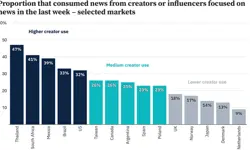
The idea is to develop talent-led original content formats for video, audio and newsletters. YouTube football channel ACFC, developed by creator Adam Clery, is one example.

Independent Studio’s activities span a wide array of verticals such as travel, music, film and food. And many are rich with potential for ecommerce — a revenue stream The Independent has built over a number of years.
Its output also includes content developed with brand partners. An example of this is deep-dive EV-related material for green energy supplier E.ON Next.
“We would have covered EVs without that commercial arrangement,” Broughton stresses. “But we wouldn’t have been able to serve our audiences with such a huge and compelling offering. So, everyone wins — most of all the audience.”
Independent Studio content is cross-promoted across different formats and platforms — YouTube, podcasts, newsletters and so on — with mutual benefit when a brand partnership is struck, and creators able to access The Independent’s six million registered targetable users.
The idea is a creator can still be themselves with the freedom to express what they want through what they are doing.
That The Independent is investing in innovation should come as little surprise as it has always done so, ever since its earliest days.
It was the first newspaper publisher to switch from broadsheet to compact, for example. It pioneered the poster-style front page. It also created a spin-off for a younger audience, called i.
But the focus now is, perhaps, more clear-eyed: ensuring that new offerings win new readers, deepen engagement further, grow existing revenue and create new revenue streams.
“There’s a huge diversity of revenue streams out there. But I think the conversation is sometimes very narrow in our industry, very defensive. As an industry, we see everything as a threat and that’s telling,” Broughton says.
“There are so many great additions to the business model now — not just things to bolt on, but things to really embrace the core of what you do.
“Getting into deep partnerships with brands who will be there with you for the long term and are willing to work with us to address the challenges they face and share in the development of the innovation we are rolling out is very, very valuable.”
Gaining audience insight
Deep engagement with audiences is another important part of the equation. And moving forward, attention is also firmly fixed on what Broughton calls ‘A2K’.
This involves converting anonymous website visitors to registered readers, building audience knowledge and delivering greater personalisation — such as through personalised content — along the way.
“We’ve seen the success of Substack and YouTube membership, people’s willingness to pay for things that they value and not all people wanting a traditional news product that they pay for. So, we have to innovate as we go,” he says.
“For The Independent, that means getting to know people better, offering different people the different products that they want, focusing on building valuable cohorts rather than one single massive audience and serving each cohort what they want.”
Back in June, the 2025 AOP judges praised The Independent for balancing “commercial success with impactful journalism” and “continuing to build its reputation as an innovative and forward-thinking digital publisher” — observations Broughton is especially proud of.
And one of the keys to this success lies in an important lesson he learned more than a decade ago, soon after becoming the title’s digital editor.
“It was that you’ve got to make sure you think about the biggest — all the opportunities there are, in the biggest form you can,” he says.
“The countless reports of the imminent death of journalism have been greatly exaggerated over the years. And we believe there is a world of opportunity out there, as I hope some of the developments we have announced recently clearly show.”
Another important factor, though, is vision.
“What we need is a newsroom that’s empowered by the business, and a business that’s empowered by the journalism,” Broughton concludes. “And having been an editor before coming over to the business side, I see that connection really clearly.”
This article was first published in InPublishing magazine. If you would like to be added to the free mailing list to receive the magazine, please register here.